Invoicing in US dollars or crypto from an Estonian OÜ: exchange rate, VAT and bookkeeping
Can an Estonian OÜ invoice in US dollars, which exchange rate to use for VAT and for the books, what to write for a US client, and what to know about crypto payments.
Many e-residents work with clients in the US, and some get paid in stablecoins. The books of an Estonian company are kept in euros, though. So where do you need an exchange rate, which one, and what goes on the invoice?
We had our own case. Opentech OÜ received a bonus package in a cryptocurrency. We issued an invoice in that coin with its price on the invoice date, and our accountant put the coin on the company’s balance sheet. Later the Starname network, where the coin lived, shut down, and today the coin has no price anywhere. Since then we pay more attention to the currency of an invoice and what follows from it.
Below is what the Estonian VAT Act (KMS), the Tax and Customs Board (EMTA) and the Estonian Accounting Standards Board say. This article follows our guide on invoicing EU clients.
This is not tax or accounting advice. Currencies, and crypto even more so, are a good topic to discuss with your accountant before you invoice.
Can you invoice in US dollars?
Yes. The law does not require an invoice in euros. There is one strict rule: if the invoice has VAT, the VAT amount must be shown in euros (KMS § 37(7)(10); EMTA).
A client in the US: 0% VAT
When you provide services to a business outside the EU, the place of supply is not Estonia (KMS § 10(4)(9)), and the service is taxed at 0% (KMS § 15(4)(1)).
For this case EMTA asks for a reference to § 15(4)(1) on the invoice. The law lets you replace the reference with other clear wording (KMS § 37(8¹); EMTA). You do not need the note “reverse charge” here. That one is for business clients in other EU countries.
So an invoice to a US client has no VAT, and the “VAT in euros” rule does not touch it. You need the exchange rate for yourself, for your books.
If an invoice in another currency does have VAT
Say you invoice an Estonian client in dollars. Then you work out the VAT in euros with the European Central Bank rate on the date set by § 11 of the law. This is not the invoice date. It is the date of whichever comes first: the service is provided, or a payment arrives, including an advance payment (KMS § 29(13) and § 11).
The exchange rate in your books
An Estonian company prepares its annual report in euros (Accounting Act, § 15). The Accounting Standards Board guideline RTJ 1 explains how to convert (paragraphs 93 to 97):
- You record a sale in another currency in euros, at the rate of the day of the transaction.
- On the reporting date you convert unpaid invoices in other currencies at the current rate. The difference goes to profit or loss as an exchange rate gain or loss.
- You do not convert advance payments again.
RTJ 1 does not name the source of the rate. Agree on it with your accountant once, and then always take the rate from the same place.
Should the invoice show the exchange rate?
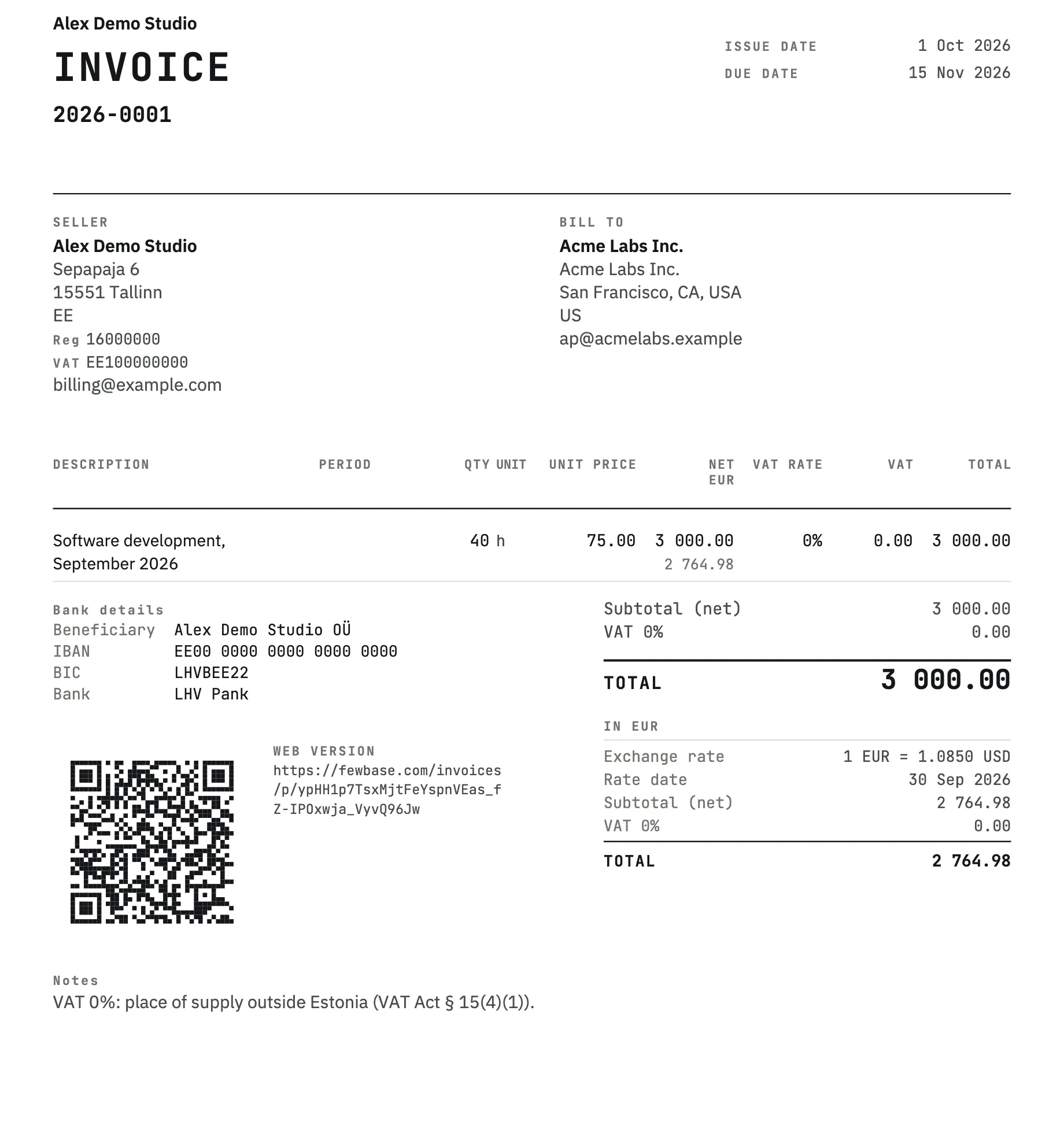
The law and EMTA do not require it (KMS § 37; EMTA), and they do not forbid it either. We show the amount in euros and a line such as “1 EUR = 1.085 USD”. It does not bother the client, and your accountant does not have to guess which rate you used.
Payment in cryptocurrency
There are fewer official rules here than anywhere else, so this part is short and careful.
VAT. The VAT Act has no separate rule for crypto payments. The taxable amount is everything you receive for the service (KMS § 12), so the service is taxed as usual: 0% for a US client, as above. In the Hedqvist case, the EU Court of Justice called bitcoin a means of payment and found that exchanging normal currency for bitcoin is exempt from VAT (C-264/14). The ECB does not publish rates for cryptocurrencies, and we found no official EMTA guidance on how a company should convert a crypto payment into euros for VAT.
Bookkeeping. There is one official document: the Accounting Standards Board’s interpretation RTT 1 on blockchain instruments (fin.ee). It does not call crypto money and does not give a ready asset class. The company’s management decides what it is for the company. A coin with an active market, like bitcoin, may be shown at fair value. A token without an active market is shown at cost, and you lower that value if its price falls. And the general rule applies: do not show assets at more than they are worth.
Our coin from the Starname network is exactly such a case. So the advice is simple: if a client wants to pay in crypto, agree with your accountant in advance how you will book it.
Checklist
- A US business client for services? 0% VAT and a reference to KMS § 15(4)(1), or clear wording instead.
- A business client in the EU? That is reverse charge, see our guide.
- An invoice in another currency with VAT? The VAT amount in euros, at the ECB rate on the date of the service or the payment.
- The rate for your books comes from one source you agreed on with your accountant.
- The invoice shows the amount in euros and the rate, for convenience.
- Payment in crypto? The network and address on the invoice are checked, and you agreed with your accountant how to book it.
How Invoices handles this
In Invoices an invoice can be in one currency while your books are in another.
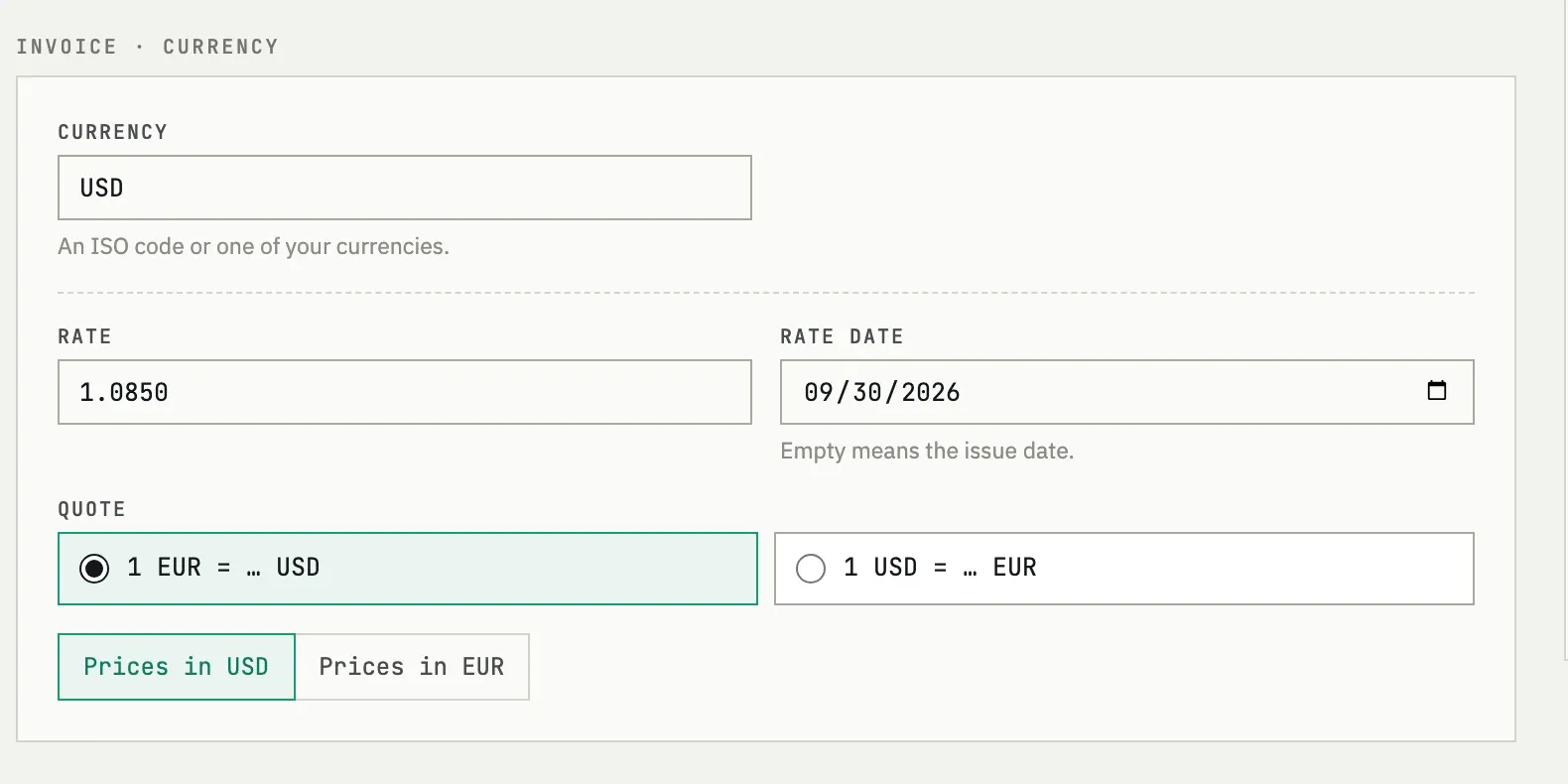
You enter the rate yourself. Invoices does not fetch rates, because what counts is the rate of a specific source on a specific day: the ECB, your bank, or the one you agreed on with your accountant. You enter the rate, its date and its direction (“1 EUR = … USD” or the other way round), the same way your bank shows it.
The invoice shows both totals and the rate line. You cannot issue an invoice in two currencies without a rate. For now Invoices has a ready tax note only for reverse charge, which is for EU clients. For a US client you set 0% VAT and write the § 15(4)(1) reference in the notes field of the invoice.
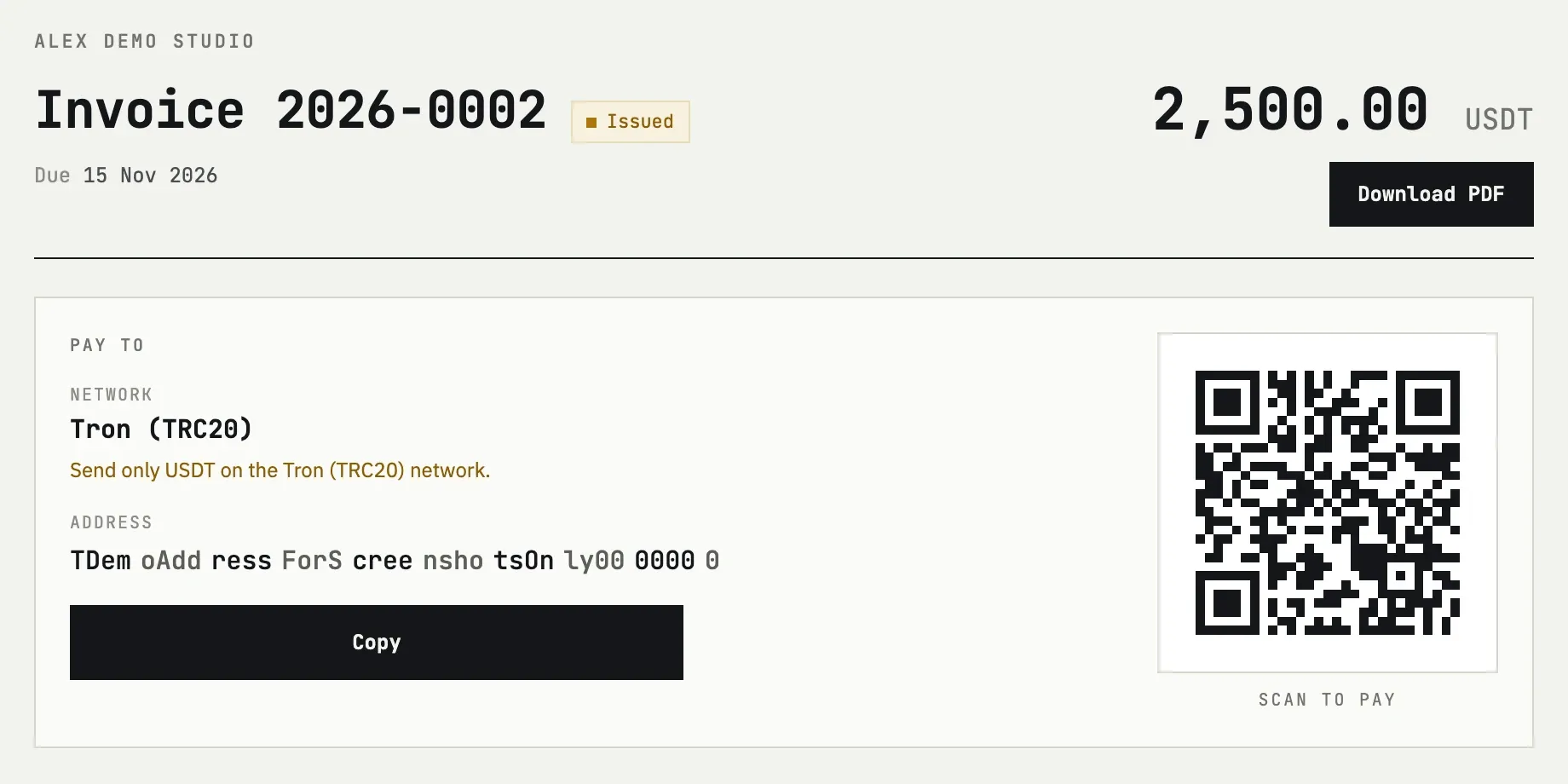
You can also add your own currency, for example USDT, with a network and a wallet address. Then the invoice shows a “Pay to” block with a QR code. Such an invoice does not print your bank details: under an amount in USDT they would look like a way to pay it. The address is copied into the invoice when you issue it and does not change later by itself.
You can start for free.
